Wednesday, February 27, 2013

G'nite Gothenburg

 A few photos from an evening stroll:

A purple hue over Gothenburg as the sun sets on Tuesday night

A bridge in the city had a note attached to it. The hashtag means "build a bridge".

Speaking of books, today marks the start of national book week in Sweden. A national ode to the book. Yet another reason to love Sweden. Book retailers participate by having huge book sales, often slashing prices in half.

My dream come true. The best candy store ever. This clip is merely 1/3 of the entire store. The rows just keep on going. I thought I had died and arrived at the pearly gates. My version of the pearly gates, anyway.

Cheeze Heartz. The company also makes Cheezy Doodles. They're branching out.

McDonalds has a new campaign in Sweden. "Tastes of America" will introduce four new burgers in the next eight weeks. First up is Kentucky with a steakhouse burger including bacon and tomato sauce. I'm guessing Texas will have its own burger before the campaign is over. Something tells me it will have BBQ sauce on it somewhere.

 I concur. This is a public service announcement of sorts. A local transportation company responsible for making sure buses, trams, and trains are on time is using their ad space to apologize for any delays, but "when you live in a country where it can snow in May", its unavoidable.

A clip from the Hard Rock Cafe in Gothenburg. They know how to treat their hometown talent right. In Gothenburg, trams run throughout the city. The name of a local celebrity is painted on the front of each one. Currently, there are no trams with Ace of Base written on the front. I'm still waiting for the city of Gothenburg to do what Hard Rock Cafe has already done - give their hometown talent some recognition! These records are prominently placed at the entrance to the restaurant just as you walk in the door.

Tuesday, February 26, 2013

Emigranternas Hus

Emigranternas Hus is a two story museum near the harbor dedicated to the history and research of Swedish immigration abroad, with a focus on American immigration from 1850-1920. The first section of the museum explores the reasons behind American immigration and how people prepared themselves to leave. The second section shows how Swedes entered into and adapted to American culture. The most common factors pushing Swedes to the New World include crop failures and a population boom. The biggest pull to move to the States were job prospects, free land, and religious freedom.

Emigraternas Hus contains a small research center where you can search the archives yourself on computer, or get help with the task for a minimal fee. The center also conducts daily school visits.  The staff compares Swedish immigration to the US with current international immigration to Sweden today. The center helps Swedes understand the challenges involved in immigrating to another country, whether that be 100 years ago or 100 days ago.

One Way Ticket to America

A trip to the United States cost a year's wages for most people, so families would elect one person to go, and together they would raise the money for the trip. That person would leave everything and everyone they know behind to make a new life. If the were successful, they would send extra money back to their family at home and each family member would also come to the US in due time.

A map created by a travel agency to entice Swedes to dream about the places they could go in the New World.

 A painting showing Swedes who are about to leave. They would often come a week early to prepare. They would buy the necessary supplies for the crossing, take one last family photo in Sweden, and buy new clothes. They also fell prey to pickpockets and swindlers who set up shop in the departure area.

Statistics on Swedish immigration to the States. The white areas represent Swedes who left. The red line indicates how many came back to Sweden after some time.

 A Swedish-American newspaper ad from 1890 illustrating the difference between Swedes who have just arrived and those who have been in the US for some time. 

An ad from the White Star Line, a company whose boats brought many Swedes to the New World.

 A Swedish shopkeeper in the States. The ad on the bottom left is in English and Swedish -"Stream Laundry. Swedish Spoken Here"

Morning in Gothenburg

A few photos and video from a morning stroll in Gothenburg on my way to the Emigrant's House:

A container to return your one-time-use grills in Slottsskogen, one of the city's biggest parks.  It's the Central Park of Gothenburg. You know a culture is serious about its grilling when they have a dedicated trash bin.

The ducks are enjoying the open water in this lake at Slottsskogen.

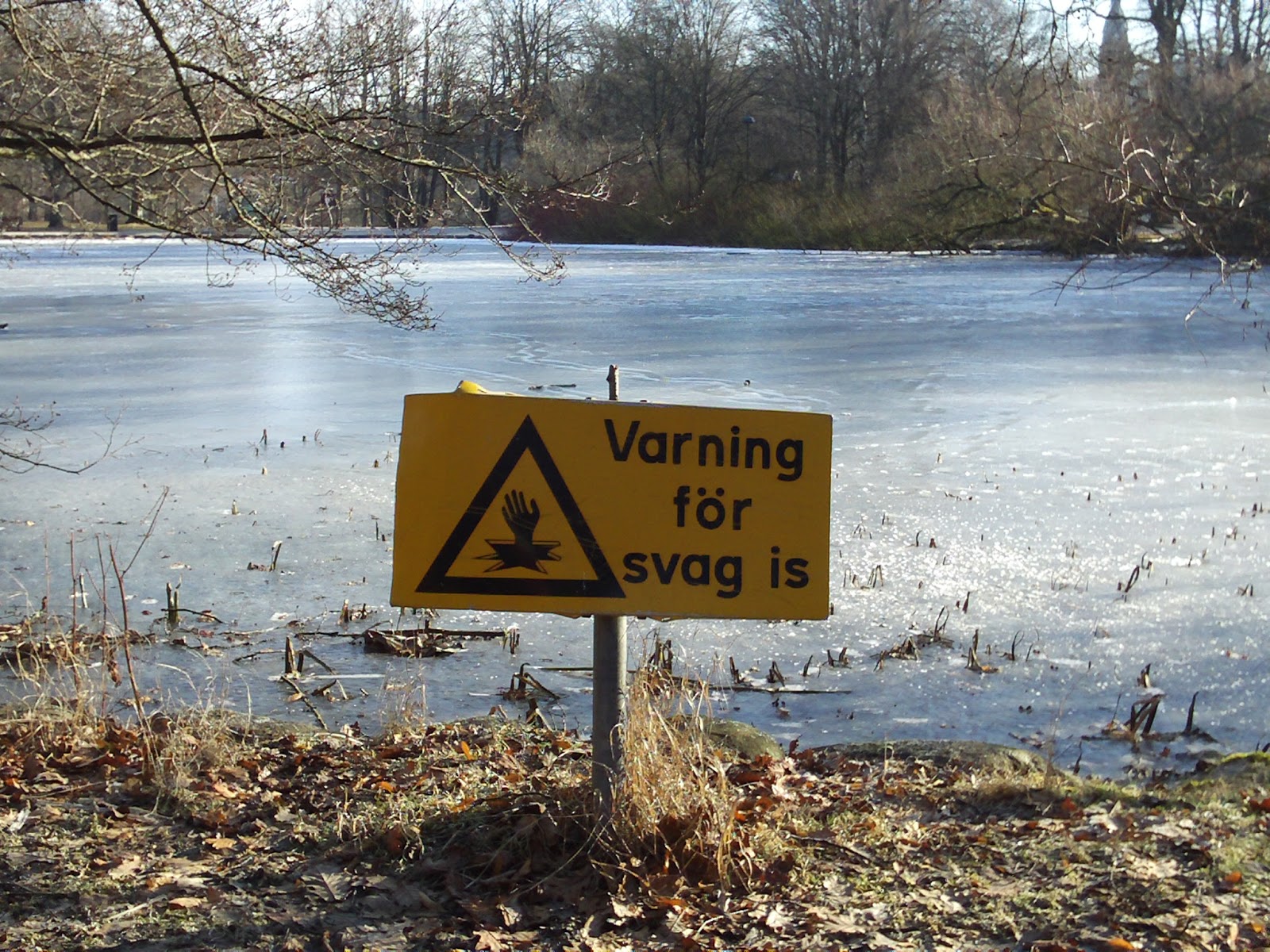
"Warning for zombies under the ice". No, it's just a sign near the lake warning of thin ice. There were a few footprints in the snow anyway. The newspapers are reporting a warm up, heralding the start of spring.

A fallen tree in Slottsskogen park. It is used as a makeshift park bench and playground by some residents. 

IKEA is drawn into the horse meat scandal in Europe. They've been unknowingly using horse meat too. The papers are reporting IKEA's decision to stop serving meatballs, for now.

"The Semla - The best thing ever"

My morning breakfast at Espresso House. An egg and "caviar" sandwich on sourdough bread. The caviar is a specialty known to all Swedes called "Kallies Kaviar" The kaviar comes in a bright blue toothpaste-lookingtube and is light pink in color. The kaviar an acquired taste, due to its high salt content. Swedes living abroad look for it like I look for semlor. I'm not a huge fan of Kalles, but going to Sweden and not eating it would be a crime, I'm sure. 

Monday, February 25, 2013

Officially Couchsurfing

I finally made it to Göteborg and have started my couchsurfing experience. Michael, who lives in the city, is hosting me during my stay. I arrived at his door a few hours ago and was promptly invited on a tour of his lovely home. Michael is a painter and his home reflects his profession. The colors are expertly applied and professionally coordinated.

We spent our first few hours chatting about Gothenburg, Melodifestivalen, Sweden, and the US. Michael came to Sweden in the early 90's and raised his family here. He speaks Swedish and is a citizen to boot. Being from LA, he loves Mexican cooking, which he misses. Trying to replicate the original recipes isn't always easy. Some ingredients like corn tortillas and habanero peppers are nonexistent. Michael is a creative guy though, so he mixes and matches flavors to come as close to the real deal as possible.

Michael is also quite thoughtful. He went to the library and checked out a mega-tome on the history of Melodifestivalen for me. It is packed with information. I'm getting an education in the song contest from a man who does not watch the show himself. You never know who might have new information waiting for you. Michael doesn't watch the contest regularly, but he does recall watching it when his son was a kid.


We also had an extensive chat about Sweden and the United States. We discussed everything from the weather and the music, to immigration and social services. We have several experiences in common such as having difficulties with the language even after all these years. His bookshelf looks just like mine: a mix of books on Sweden in both Swedish and English, along with dictionaries for both languages.

Right now, it's time for bed. I've got my own bed in the living room. Michael set out a mattress, covers, and a pillow for me and has given me my own private space so I can get a good night's sleep. 

Tomorrow, I'll head out to the Emigrant's House in Gothenburg and learn more about Swedish Immigration to the United States. Later on, I'll meet other Couchsurfers for a chat about the Mello results so far.

Ugly American

I missed my bus to Gothenburg today. I was fifteen minutes early and was waiting in the right spot, or so I thought. The TV screen showed the bus would leave from place M, and guess what was sitting outside the window? A sign with a big M on it.


I stood there and waited. This is Sweden and things are typically on time, so when five minutes passed, I wondered. But, I've taken Swebus before, so I know they can be a little late. Fifteen minutes passed. Twenty. Thirty. "Ok, that's too much. I've waited long enough," I thought.

I re-charged my SIM phone card and called Swebus. I said, "What's up with this?" The representative looked and couldn't find any delays. Their computers showed the bus had been on time and had left on time, too. He said I was in the wrong place. I, feeling confident I was in the right, argued that the ticket said Centralstationen and the TV screens within the Central station showed the bus leaving from place M.


He told me I must be in the wrong place and I said I wasn't. We went around and around because I thought I was right. He said I should look at the ticket to see it said the bus leaves from a place called Svävarterminalen/Centralstationen. I got angry, realizing I would have to buy another ticket and blurted out, I won't be using Swebus again. He said, "You need to blame yourself. You were in the wrong place". I was still angry, so I just said, "Yeah, thanks. Bye".

That reply from the Swebus employee would raise hackles in the United States, even if a customer was in the wrong and was angry. In Sweden, people don't mince words. They go straight to the point. Things are they way the are and Swedes will tell you without reservation.

I walked up to someone in the Central Station and asked where Svävarterminalen could be found. They didn't point to the spot outside the window where I had been standing before. Instead, they said that terminal was about half a mile from the Central Station.  Man. I hate when I'm wrong.

And, yes, the truth hurts. You think you know a country and how things work. You think you have everything down. "I can't be wrong! I've traveled all over this country! I know what I'm doing!" Until I don't.

I have to swallow my pride and apologize to the Swebus employee I spoke with for my ugly American behavior. The customer representative was right. It is my fault and I must blame myself for not double checking. (Although, it would be nice if Swebus took the words Centralterminalen off the ticket entirely and replaced it with Svävarterminalen only.)

Now, I'm on the train to Gothenburg instead. Tired, but happy to be going in the right direction.

Sunday, February 24, 2013

10,200 Expectations

Yesterday's competition in Malmö Arena held 10,200 spectators. Each person has an individual expectation of the evening's event. I spoke with a handful of spectators before the show about the program.

Friends Maria and Johanna ready for the show to begin.

Decked out in little pink crowns and lovely feather boas, Maria and Johanna were in high spirits. Their smiles radiated across the rows and their joy spread to those around them. I was swept along in their happiness when I walked by and was given their camera to capture the moment. I took the chance to take my own photo of the moment and to ask them about their visit.

These two friends grew up watching the program on TV. This was their first visit to the live event. They decided to go all out, as you can see. Is there anything especially Swedish about the show? Johanna thinks it is more European since it is a qualifier for Eurovision. Maria added that different countries have specific qualifying systems. Germany, for instance, has one singer perform every entry and people vote on the best song. So, the system of qualifying could be seen as Swedish, Maria suggested. Johanna considered the question further, "The Swedish winter is more fun because of it. Every Saturday you look forward to it. You can look forward to it after Christmas is over." Did they have a favorite song this evening? "No! We have not decided yet. This will be the first time we hear the songs live. We wanted the whole live experience", Johanna added.

Looking around, I noticed more fans decked out in fancy feather boas. I saw a woman with a long pink feather boa sitting with her husband, Jonas. Ingela had just purchased her boa minutes before I arrived. I asked her to explain the phenomena, and she said "I have a boa because this is a party. It's a party atmosphere." This was the first time Ingela and Jonas had seen the production live and the first time she bought a pink boa, she noted. What is Swedish about the contest? "Everything!", Ingela mentioned. Jonas thought it was the artists that made it especially Swedish.

It was 6:55 PM and the house band started setting up. Before the band got underway, I stopped to chat with Annika and Stephen. They sat in the first few rows waiting to be showered with hearts and fire. Before the show and all its ensuing antics, I asked them about their experiences. The pair had been at the rehearsal show last year and planned to be at the live even this time around. What is Swedish about the contest? The experience factor looms large for Annika. "In Sweden, you don't have many shared cultural experiences. Twenty five years ago, people watched the same TV show or movie. Today, it is not too common." Shows like Melodifestivalen bring people together around one central touchstone. Annika added, "If you don't watch, you won't have anything to talk about at the office on Monday."

Views from Malmö


A permanent marching band sculpture in the middle of a busy pedestrian walkway. Tourists love to stand in the empty spot and strike a pose.

This is King Karl X Gustaf who conquered the city when it was Danish and handed it back to Sweden in 1658. Today, you might think he's famous for conquering the competition in Melodifestivalen. The flags waving in the breeze are Mello flags.

Malmö is known as an international area, with residents from every country living here. It shows in the food choices around town. You can find any type of food you want. Chinese, Italian, Mexican, Swedish, Danish, German, Middle Eastern, Thai, Texan. (What? Texas is almost its own nation. Don't you know that?!) The international food list is endless. You can still see the Swedish influence in the food, however.

Chinese food next to the national Swedish convenience store on the right, Pressbyrån.

A version of Latin American cooking in Sweden, complete with cartoon mascot.  

The American section of a grocery store. Popcorn salt, "marshmallow fluff", frosting,  Swiss Miss, cheesecake, brownies, American pancakes, Skittles, and "Frootmallows".

I bought my dinner from a pizza/falafel restaurant. This is a clam and shrimp pizza. Yum!

 Folk & Rock, winner of best cafe 2012. It's a cafe/music store combination Swedish food and music together. This is my kind of place. I stopped by yesterday to eat there, but it was so busy, there were no seats available! Looks like it is on track to win in 2013 too.

The city does sing! This store's song? Fastlagsbullar - another name for a semla. I saw the sign! This is where I decided to get my first semla since 2004....

which didn't last long.. All gone.

This was full of semlor when I arrived. Thirty minutes later, there are three left.

A long pedestrian street where families take a quiet Sunday stroll to work off those fastlagsbulle calories

St. Petri church in the center of town. It was built in 1393 in the Gothic Style. The tower is 344 ft/105 meters tall.
A bike path underneath a busy road. The path has its own lane markers and street lights. Swedes are serious about safety.

 A native of Southern Sweden. Scania trucks, like this one, originate from this very area. Swedes call this region Skåne. In English, it's known as Scania.

 The tabloid papers post the daily headlines in huge font. Tabloids are also known as "yellow journalism". Maybe the term originated in Sweden? This particular paper talks about the Army of Lovers and their half-naked Schalger performance yesterday. The bottom is about weighing more. Looks like the BMI scale has changed, so you can weigh even more now and still be considered healthy. I'm in luck!

Imposter! Imposter! This Death Star and R2D2 are made of Lego blocks and those are Danish. Sure, Karl X Gustav kicked out the Danes in the 1600s, but it doesn't mean it stayed that way. Today, Copenhagen and Malmö have strong economic ties with each other. The ties were further enhanced after a bridge was built between the two cities in 1999, making it possible to travel between the two countries directly by car in about half an hour.