Showing posts with label Swedish Music. Show all posts

Monday, March 18, 2013

Thanks for Reading!

Artist Terese Fredenwall's participation in Melodifestivalen sparked my trip to Sweden and the subsequent writing of this blog.

Her song, "Breaking the Silence", is now out on iTunes. If you enjoyed following my Mello journey, please consider supporting my favorite Mello artist of 2013 by adding her song to your Spotify or Wimp playlists, or by buying the single on iTunes.

Thanks for reading Semlor and Song!


Semlor and Song: Cultural Connectors

I went into this journey thinking Melodifestivalen would be celebrated like the Super Bowl. The TV viewing numbers say as much. Almost half the country watches. I thought people would be pumped about the contest and all its trappings - and everybody would watch. I imagined people would sit down with friends and family to see the spectacle with a big spread of food and everybody would be talking about it - for six weeks straight.

It was sort of like that, but not quite. The final show in Stockholm followed a Super Bowl-like pattern, minus the commercials. Almost everybody watched and many people gathered together with food during the final show. There's no doubt everybody was talking about it the next day. The previous five weeks of the contest were... a bit more muted.

Things aren't always the way I expect them to be in Sweden, even though I'm familiar with the culture. It's good to know there are still surprises to be found after more than a decade of study.

Even though I look at Sweden through an experienced frame of reference, I still filter it through American eyes (or maybe Swedish-American eyes). I expected Melodifestivalen to be a well-loved party where everyone celebrates the contest and the artists in a big way. I expected an excited and positive response when I mentioned blogging about the show. The biggest response I got was, "That's kinda crazy" followed by "I don't watch the show." I thought the host cities would hold parties and large events for the general public. Karlstad tried to promote the show, although you could have stayed in Stockholm and Malmö without ever knowing Mello was happening just a few minutes from your location. Like I said, it was muted. Or, muted in an American sense. It was not what my American self had in mind.

A popular show, but not in the American sense.

I learned the show isn't so much a well-loved party as it is a well-known cultural touchstone. Everyone knows about it and has a relationship to it, either positive or negative. The show itself fills many cultural and social functions throughout its six week run. It's a way for people to escape from the daily grind for a few hours each weekend. People also use the contest to share thoughts and opinions. They use it to find new music and artists for their playlists. Using it for an excuse to party is also popular, although Swedes don't have much trouble finding reasons to go out on a Saturday night. All these functions have one thing in common - connection.

Melodifestivalen connects people. Whether you love or hate the show, you are connected to other people through its appearance every year. It gives people the opportunity to talk with each other and build relationships around the things they experience, whether that be a shared love of the contest and the songs or a shared dislike of the entire phenomena.

Folk 'n' Rock, a popular cafe in Malmö. It's a combination cafe and music store. A good place to make connections, both personal and musical.

It's the same story for semlor and Swedish food, apparently. Connection is the key. In Italy or France, the taste of the food and the experience of eating is held in high regard. In Sweden, the food isn't the star of the show. It's the people you're sitting with while you eat. Taking a coffee break, aka fika, or sitting down with a meal gives people the opportunity to relax and really connect with the person sitting across the table. Semlor play a special role in such connections since their appearance is seasonal. It brings something special to your fika time since the traditional pastry tends to bring back memories and events from previous years. What were you doing when you ate your last semla? How has your life changed since then? Such thoughts pop into your mind. They make for good discussion topics with others as you connect over food.

Helena Wahlman/imagebank.sweden.se
Cinnamon rolls are also popular fika food.

While the contest has ended and semla season is soon over, the memories remain. Next year, the same process will repeat. People will eat and listen - and connect. Old friendships and relationships will be strengthened. New ones will be formed. And the culture will grow richer because of it. All this because of a little semlor and song.

Semlor - making connections between people in Sweden for centuries.

__________________________

I connected with many people during my stay in Sweden. Food and music played a vital role in each encounter. Many people opened up their hearts and their homes to me during my stay as well. My gratitude cannot be expressed in words, but I must say thank you anyway:

Thank you to Nordstjernan for giving me the opportunity to contribute to your publication. And to everyone I spoke with during my stay, I say thank you for your insight into the contest and the culture!

A special thank you goes to CouchSurfers Michael, Emma, Christian and Alexander, along with Sara and the entire congregation at Missionskyrka in Gnosjö for giving me a place to call home while on the road.

Another big thank you to dancer and actor Ausben Jordan, Pia Andersson from Melodifestivalsklubben, Ann-Charlotte from Ave Produktion, singer and author Jenny Berggren, and Andreas at the Swedish-American Center in Karlstad for sharing your time, insight, and knowledge with me during our longer discussions. You provided in-depth insight into the contest in a way I could not have reached otherwise.

A final thank you to everyone reading the blog. I hope you enjoyed reading it as much as I enjoyed writing it. Maybe one day you'll go to Sweden to see Melodifestivalen yourself. If you do, be sure to eat a few semlor for me!

Saturday, March 16, 2013

The Full Results


The final placement of all 32 songs in Melodifestivalen 2013:

1. Robin Stjernberg – "You": 166 points in the final
2. YOHIO – "Heartbreak Hotel": 133 points in the final
3. Ulrik Munther – "Tell the World I'm Here": 126 points in the final
4. Anton Ewald – "Begging": 108 points in the final
5. Louise Hoffsten – "Only the Dead Fish Follow the Stream": 85 points in the final
6. Sean Banan – "Copacabanana": 78 points in the final
7. Ralf Gyllenhammar – "Bed on Fire": 73 points in the final
8. David Lindgren – "Skyline": 69 points in the final
9. State of Drama – "Falling": 68 points in the final
10. Ravaillacz – "En riktig jävla schlager": 40 points in the final

11. Martin Rolinski – "In and Out of Love": 183,694 total votes in the Second Chance round
12. Behrang Miri – "Jalla Dansa Sawa": 168,679 total votes in the Second Chance round
13. Erik Segerstedt & Tone Damli – "Hello Goodbye": 70,523 total votes in the Second Chance round
14. Caroline af Ugglas – "Hon har inte": 35,234 total votes in the Second Chance round
15. Cookies N Beans – "Burning Flags": 25,826 total votes in the Second Chance round
16. Eric Gadd – "Vi kommer aldrig att förlora": 14,164 total votes in the Second Chance round

17. Terese Fredenwall – "Breaking the Silence": 57,492 total votes in the semi-finals
18. Felicia Olsson – "Make Me Number 1": 55,049 total votes in the semi-finals
19. Janet Leon – "Heartstrings": 50,251 total votes in the semi-finals
20. Mary N’diaye – "Gosa": 23,436 total votes in the semi-finals
21. Eddie Razaz – "Alibi": 19,476 total votes in the semi-finals
22. Amanda Fondell – "Dumb": 18,488 total votes in the semi-finals
23. Swedish House Wives – "On Top Of The World": 17,172 total votes in the semi-finals
24. Army of Lovers – "Rockin' The Ride": 16,867 total votes in the semi-finals
25. Sylvia Vrethammar – "Trivialitet": 13,609 total votes in the semi-finals
26. Michael Feiner & Caisa – "We're Still Kids": 12,098 total votes in the semi-finals
27. Lucia Pinera – "Must Be Love": 9,219 total votes in the semi-finals
28. Anna Järvinen – "Porslin": 8,689 total votes in the semi-finals
29. Rikard Wolff – "En förlorad sommar": 7,785 total votes in the semi-finals
30. Elin Petersson – "Island":7,494 total votes in the semi-finals
31. Joacim Cans – "Annelie":7,069 total votes in the semi-finals
32. Jay-Jay Johanson – "Paris":5,526 total votes in the semi-finals

Thursday, March 14, 2013

Competition and Swedish Culture

During the CouchSurfing meeting in Karlstad, I had the chance to chat with several locals about many different topics. Our meeting began at a local restaurant called Tempel. When we walked in,  the waitress invited us to take part in a Melodifestival contest. Each team was given a piece of paper with a crossword puzzle on it. The restaurant played different songs and provided clues to each answer. Our job was to fill in the puzzle and try to win.


There were about six teams in the entire restaurant. Our big group made up half of the teams on its own. Emma named our team, "Houston, We Have A Problem" because we were clueless when it came to the first three clues. We ended up in the middle of the pack by the end, which isn't bad considering our terrible start.

After the competition, I had the chance to ask several of the local CS hosts,"Why is Melodifestivalen so popular?" The most popular answer centered around competition. Swedes love to compete and they love to watch competitions, too. I could see this. We just finished a competition against other teams in the restaurant, after all.

How important is competition to Swedish life and culture? It's not exactly encouraged in all places. School and work is all about teamwork, thus competition can be frowned upon in these places. But, when it comes to sports and music and similar pursuits that pit one person against the other on a fair playing level, Swedes hold nothing back.

Sweden excels in many international contests. The NHL is full of Swedish-born players. The national soccer teams do their best to qualify for the World Cup. And Swedish Olympians are always highly celebrated, especially when they return with a medal. The country even holds a national award banquet for sports competitors similar to the Oscars, Grammys, or Golden Globe ceremonies in the United States. Competition is a big part of the culture and encouraged -  in the right forum.

 Rodrigo Rivas Ruiz/imagebank.sweden.se
Swedes also compete in digital gaming and graphics. DreamHack is the world's largest computer festival, with a quarter million in prize money up for grabs. Parts of the competition are shown on Swedish TV.

It's the fair type of competition Swedes enjoy watching. They are not fans of cutthroat competition, but fair and level contests are popular. Is the competition factor the main reason the song contest is so popular? No, it's not the whole story. The idea of competition does, however, go a long way in explaining why many Swedes who don't care for the music watch anyway. They're drawn in by the competition and the fight and the crowning of a big winner.

Mello's Economic Boom

It costs money to put on a six week tour all around Sweden, of course, but the money spent doesn't compare to the money made on the contest. According to one newspaper, broadcaster SVT made about 20 million dollars (120 million kronor) off Melodifestivalen this year. The total includes money from event arrangers who want to sell tickets in their arenas, city officials who want tourists in their town, and advertisers who want their products in the hands of consumers among others.

The contest is serious fun and serious business, which may explain its expansion from one night to six weeks. It's just too lucrative a show for a single evening. Expand the contest and you've effectively expanded your income six-fold. It's good for the broadcaster and good for other companies involved, too.

The promotional powerhouse that is Melodifestivalen creates jobs, sells products, engages songwriters, promotes artists, sells records, requires camera crews, techies, dancers, choreographers, and background singers. It helps city councils by boosting tourism. Hotels and hostels sell out rooms. Airlines, taxis, and bus companies profit. Souvenir seekers buy merchandise and goodies like pink hats and feather boas. And the list continues.

There are no official numbers on the overall economic benefit of the contest. If a study were done, I would suspect the results would show an enormous benefit to the host city, the broadcaster, the ad sponsors, and the arena hosts. The audience is the key to the entire structure. Without viewers, any economic benefits would be negligible. Who knew buying a ticket, a cowboy hat, and a feather boa helps Sweden's economy prosper?

Economic opportunities abound during the contest:

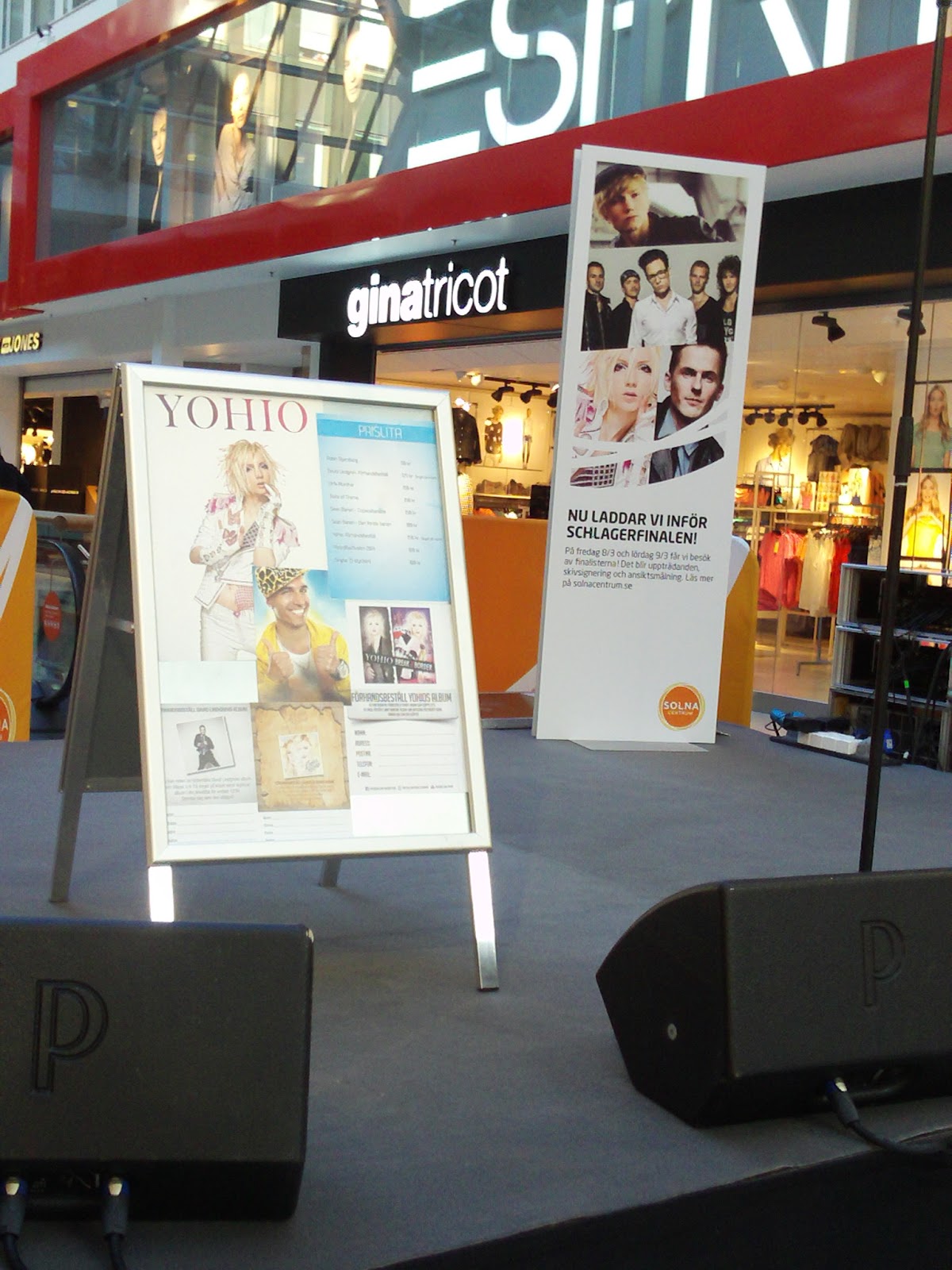
Buy CDs, singles, or pre-order the artist's new albums at this booth. 

Shopping malls get into the act. Artists make appearances and attract the mall's target audience. Sales go through the roof as a result - or so the shopping mall hopes.


"Get ready for the music party of the year!" The more chocolate you buy, the more money you save.


Taxis waiting outside of Friends Arena. This is a small sampling of the dozens waiting to take the festival audience home for the evening. 

Limited edition chips made just for the occasion. These samples were handed out free both before and after the live event.

This scene repeated itself during every stop on the tour. The merchandise booths and company booths were always swamped. The booth on the left-hand side is giving away coffee, hence its overwhelming popularity.

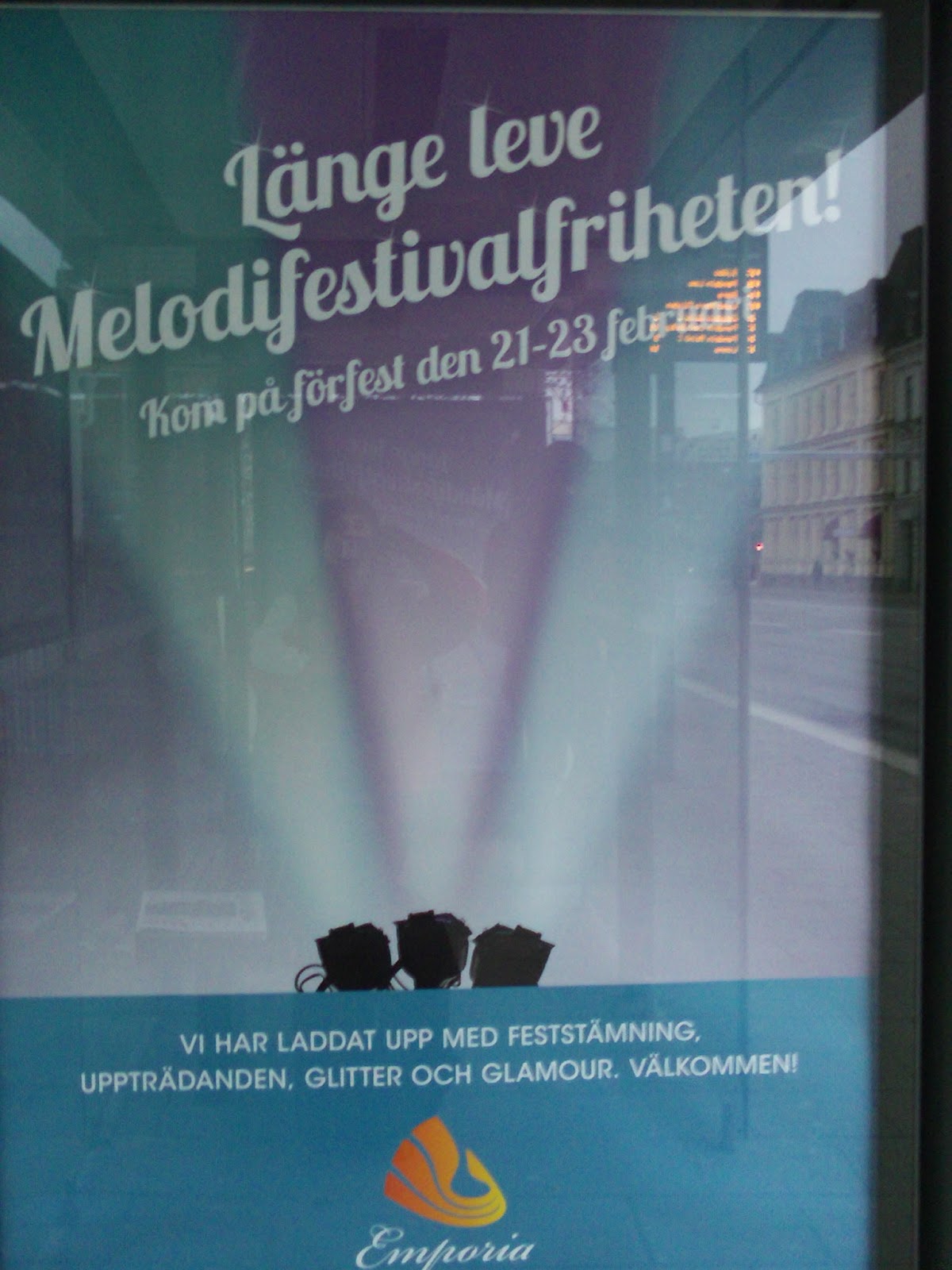
A bus stop ad in Malmö. "Long live Melodifestival freedom". The company wants you to know the shops around Malmö arena will be open late, so you can shop after the concert is over.

A bakery gets into the act. "Malmö sings". This simple ad worked for me.

Sunday, March 10, 2013

Sunny Stockholm

It's another blue sky day in Stockholm.  Today marks my last full day in the city until I begin my travel back home. I just said goodbye to Alexander,  my last CouchSurfing host. He took me out for a mini semla before we parted ways at the central station.

Alexander showed me several sights around town, including the Royal Library, which was a first for me. We ate at several nice places in town and enjoyed chatting about Sweden, the Netherlands, and the United States during our walks. Alexander is currently in an intense study period for his engineering exams. Even though he's busy with his studies, he took time out to show me around Stockholm. For that and all his hospitality, I am grateful!

Opinions about last night's Mello show are still going strong. Everyone at the central station and on the subway was talking about the show after Alexander and I left the student center. The biggest point of conversation was the international jury vote. This contest marks only the third time since 2005 where the official jury's vote changed the end result. This isn't sitting well with the public, since many people feel the general public should have the final say. A few of the newspapers are reporting difficulties voting as well. I sent in a few votes myself and am unsure if any of those made it through. That's not real news though. It happens every year. When you have a million votes trying to get through in an hour and a half, some just won't make it.

I hear there's a song church service at nearby St. Clara church in about an hour. I'll head there and then it's off to find a few interesting things to bring home to family and friends.


Thursday, March 7, 2013

Sweden's Tradition of Song

Swedish culture is awash in song. Children usually learn an instrument when they're small, or at least try. Singing in a choir is a near national pastime with one of every seven people involved at some point. Music is an integral part of almost every holiday and celebration. And many of the biggest TV shows revolve around music (Så Ska Det Låta, Allsång på Skansen, Maestro, Så Mycket Bättre, Melodifestivalen....)

Rodrigo Rivas Ruiz/imagebank.sweden.se

In a country the size of California, the industry is booming. More people work in the music industry than in the automobile industry. It's not just within the country, but also outside its borders too. Some of the biggest International acts get help from Swedish songwriters and producers.

American Artists who've worked with Swedish songwriters and producers include Christina Aguilera, Brittney Spears, Jessica Simpson, Kesha, Madonna, Jennifer Lopez, Cyndi Lauper, Kelis, Janet Jackson, Santana, LeeAnn Rimes, Bon Jovi, Carrie Underwood, Katy Perry, Kelly Clarkson, Taylor Swift, Pink, etc.

You'll notice the above list is dominated by pop acts. Swedes excel in the genre and are often asked to write original material for other projects too, such as Glee and American Idol.

With so many talented singers, songwriters, and producers to pull from, it's no wonder Sweden's Eurovision qualifier developed into such a large production.

Saturday, March 2, 2013

Midnight Concert in Örebro

The Ritz club opened at 10 p.m. with a line at the door. The locals at the club were surprised to find out they had to wait at the door. The club opened on time, although the dance floor went unused for a good thirty minutes. People started streaming in around 11 pm and the floor was packed thirty minutes later.

Advertisement outside of the club.


Just inside the club as it opened the doors.

Someone walked up to me a little later and asked me in Swedish, "What's your name?" He introduced himself as Dimitri, a fan I've spoken with online but never met in reality. We talked about the concert, the club, and previous performances. Around Midnight, the dance floor was packed and about twenty minutes later, people started moving up to the front of the stage.

At 12:30 a.m., Jenny Berggren took the stage and proceeded through a 40 minute eleven song set. The set opened with a rendition of Happy Nation and proceeded through both Ace of Base songs and her own solo work.

A few clips from the show:


All That She Wants

Dying to Stay Alive

Lucky Love

Free Me

The full, better quality videos have been sent to jennyberggren.net

After the show, we spoke with the club manager to see if we could chat with Jenny's group before they left. However, he told us it would not be possible this time. We ended up at a pizza restaurant with a guy named Rickard who showed us around town and told us a few stories about Örebro until Dimitri had to leave for his bus to Stockholm.

Friday, March 1, 2013

Hello from Örebro!

The ice skating was great fun! It is much harder than it looks. We were able to skate on one of Sweden's biggest lakes, lake Vänern. It is frozen solid. Emma told me the ice is so thick, it could comfortably hold a car even though you could see large splits in the ice. In fact, people sometimes drive cars out onto the lake and lock up the wheels on purpose for an unforgettable ride. We also walked through the city park called Mariaberget, which includes many historical buildings, a petting zoo, and a kids playground. I enjoyed it tremendously.

Listen to the crunch. A path has been cut through the snow for skating.

Jonatan told me a little bit about his work with Melodifestivalen today as well. Photography is his hobby and he was able to step in and help this year when a fan website needed people to cover the event. He has been traveling around to all the qualifiers in Sweden and will be in Stockholm too. He said he took about 3,000 photos at yesterday's rehearsal and 8,000 in Malmö last week. Of those, he will get about 100 usable photos. I also thought my backpack was heavy. Seeing Jonatan's backpack helped me put things into perspective. He carries around a lot of equipment to get the job done. You can see some of his handiwork here at Poplight.se.

I said goodbye to my second set of CouchSurfing hosts a few hours back and have arrived in Örebro. I've also settled into my hostel for the evening. The Ritz Nightclub opens its doors at 10 p.m. and closes at 2 a.m, so the night has just started. The club plays a blend of 80's and 90's music with a touch of today's tracks. This evening, they have promised to play several Ace of Base songs as well. Bonus. There is no word yet on when Jenny Berggren will take the stage.

I've been getting my recording gear ready to use by emptying used memory and replacing batteries. I expect to run through a lot of both. For now, I will head out shortly in search of more of my favorite Swedish foods before the club opens up.

Saturday, February 16, 2013

Schlager is not a Beer

After listening to a few clips from the contest already, you might be wondering how to classify the music. Let's call it complicated.

It's pop. It's rock. It's rap. It's reggae. It's schlager. It's dance. It's everything.

Wait, wait. Back that train up. Schlager?!?

When people use everyday language to describe the Mello sound, they sometimes use the word schlager. While schlager sounds like a type of beer, it's actually a word meaning hit or to hit. What that means for music can vary. You could say it's pop music, but that doesn't quite capture it. Listen to a few examples of schlager and see if you can pick out a better phrase for the genre:

Jenny Silver - Something In Your Eyes  - 2011 (SVT)


Charlotte Nilsson - Take Me To Your Heaven - MF/Eurovision winner 1999 (SVT)


Carola - Främling 1983 Mello winner/3rd at Eurovision  (SVT)

Have you discovered the link between these songs? An expanded definition of schlager would be pop songs with a catchy hook and melody centering on subjects like love and relationships. Many schlager songs also contain a key change near the end. You might call it easy listening. I like to define it as bubblegum pop, although some fans might disagree with me since schlager is generally not targeted toward teens. Otherwise, they two genres have a lot in common. Both sticky sweet and irresistible! My kind of music.

While schlager might be the original sound of Melodifestivalen, it's not as common as it once was. Some fans are not pleased with this development, while others prefer the newer mix of sounds from other musical genres. Way back when, schlager had a place in almost every song and a common nickname for the contest was "Schlagerfestivalen". Nowadays, the song field is much more diverse. We'll explore the phenomenon of schlager more as we move along in the competition.

Friday, February 15, 2013

Melody who?

Since we have introductions out of the way, it's time to introduce the big star of this blog! That Melody Festival thing I mentioned before. If you're a Swede, you know what Melodifestivalen is all about. You might love it, hate it, avoid it. You still know about it. The American and Swedish American audience might need more background.

Take a seat and I'll call roll. It's time for Mello 101.

First: It's a song contest, there's a jury, and the audience has a role in voting for the winner. Sound familiar? Don't be fooled: It's not American Idol. This song contest has been running strong since 1958.

You've heard this one before. Can you sing along?

ABBA in Melodifestivalen 1974


Second: The contest has changed formats, but the goal is always the same: Pick a song that will best represent Sweden in an international song competition called Eurovision. Countries all over the continent gather in May to see who has the best song. Eurovision started as a way to unite Europe during the post-war years. Melodifestivalen is sometimes called the Swedish Eurovision Contest in English. Swedish fans just call it Mello for short.

Loreen (and dancer Ausben Jordan from Texas) - Melodifestivalen winner in 2012...

and Eurovision winner in 2012. This means Sweden hosts Eurovision in May.

Third: The field starts with 32 songs and artists. The field is broken into four semifinals (eight artists assigned to each semifinal). The artists are a mix of household names and new faces who compete directly against each other. Singers can choose any language, but the song has to be 3 minutes or less.

The winning song in 2009 was in French and English:

It placed 21st of 25 in Eurovision. An uncharacteristically low placement for Sweden.

Fourth: The contest is like an Everlasting Gobstopper. It lasts a crazy long time. Six weeks in all. The first four weeks are semifinals. The fifth week is a second chance round. The sixth week is the final where the remaining eight artists compete for the chance to represent Sweden in May.

Fifth: It's huge in Sweden! I'm talking Super Bowl numbers. The audience is loyal throughout the six week tournament.There are only 9.5 million people in the whole country. Last week, 3.6 million of them sat down to watch part two of six - on a Saturday night!

That's the bare bones explanation of Sweden's biggest entertainment event of the year. Now that you're versed in the basics, you're ready to follow along as we visit Malmö for the fourth semifinal, Karlstad for the second chance round, and Stockholm to pick our 2013 winner.

Thursday, February 14, 2013

Sara, the wannabe Swede

I have no ancestry no heritage, no relatives in Sweden. Most Americans have some type of connection whether it be family, or work, or history. I found a different type of connection instead. A connection to the country through my headphones. In 1994, Swedish music was all over the radio, much as it still is today. And it was this interest in Swedish music (and Ace of Base in particular) that caught my attention. It sparked my interest in Sweden and made me want to learn more, so I signed up as an exchange student for a year-long adventure. I picked up my luggage and moved out. I came back with a new language, a new outlook, and an enduring love for the country.


My exchange year is long over, but it established connections that will never end. I still take an active interest in all things Sweden and Swedish American. I help out at Swedish events in Texas. I take trips to see Swedish sights in America (Museums, towns, significant places). I subscribe to Nordstjernan, a Swedish newspaper in America publishing since 1872! I (im)patiently wait for the print version to arrive in my mailbox at home and read every page in every issue.

When I decided I would finally see Melodifestivalen in person, I contacted Nordstjernan about writing a blog for their site and newspaper. They were just as excited about the concept as I am. So, thank you to Nordstjernan for highlighting the blog and assisting along the way!