Showing posts with label Melodifestivalen. Show all posts

Monday, March 18, 2013

Semlor and Song: Cultural Connectors

I went into this journey thinking Melodifestivalen would be celebrated like the Super Bowl. The TV viewing numbers say as much. Almost half the country watches. I thought people would be pumped about the contest and all its trappings - and everybody would watch. I imagined people would sit down with friends and family to see the spectacle with a big spread of food and everybody would be talking about it - for six weeks straight.

It was sort of like that, but not quite. The final show in Stockholm followed a Super Bowl-like pattern, minus the commercials. Almost everybody watched and many people gathered together with food during the final show. There's no doubt everybody was talking about it the next day. The previous five weeks of the contest were... a bit more muted.

Things aren't always the way I expect them to be in Sweden, even though I'm familiar with the culture. It's good to know there are still surprises to be found after more than a decade of study.

Even though I look at Sweden through an experienced frame of reference, I still filter it through American eyes (or maybe Swedish-American eyes). I expected Melodifestivalen to be a well-loved party where everyone celebrates the contest and the artists in a big way. I expected an excited and positive response when I mentioned blogging about the show. The biggest response I got was, "That's kinda crazy" followed by "I don't watch the show." I thought the host cities would hold parties and large events for the general public. Karlstad tried to promote the show, although you could have stayed in Stockholm and Malmö without ever knowing Mello was happening just a few minutes from your location. Like I said, it was muted. Or, muted in an American sense. It was not what my American self had in mind.

A popular show, but not in the American sense.

I learned the show isn't so much a well-loved party as it is a well-known cultural touchstone. Everyone knows about it and has a relationship to it, either positive or negative. The show itself fills many cultural and social functions throughout its six week run. It's a way for people to escape from the daily grind for a few hours each weekend. People also use the contest to share thoughts and opinions. They use it to find new music and artists for their playlists. Using it for an excuse to party is also popular, although Swedes don't have much trouble finding reasons to go out on a Saturday night. All these functions have one thing in common - connection.

Melodifestivalen connects people. Whether you love or hate the show, you are connected to other people through its appearance every year. It gives people the opportunity to talk with each other and build relationships around the things they experience, whether that be a shared love of the contest and the songs or a shared dislike of the entire phenomena.

Folk 'n' Rock, a popular cafe in Malmö. It's a combination cafe and music store. A good place to make connections, both personal and musical.

It's the same story for semlor and Swedish food, apparently. Connection is the key. In Italy or France, the taste of the food and the experience of eating is held in high regard. In Sweden, the food isn't the star of the show. It's the people you're sitting with while you eat. Taking a coffee break, aka fika, or sitting down with a meal gives people the opportunity to relax and really connect with the person sitting across the table. Semlor play a special role in such connections since their appearance is seasonal. It brings something special to your fika time since the traditional pastry tends to bring back memories and events from previous years. What were you doing when you ate your last semla? How has your life changed since then? Such thoughts pop into your mind. They make for good discussion topics with others as you connect over food.

Helena Wahlman/imagebank.sweden.se
Cinnamon rolls are also popular fika food.

While the contest has ended and semla season is soon over, the memories remain. Next year, the same process will repeat. People will eat and listen - and connect. Old friendships and relationships will be strengthened. New ones will be formed. And the culture will grow richer because of it. All this because of a little semlor and song.

Semlor - making connections between people in Sweden for centuries.

__________________________

I connected with many people during my stay in Sweden. Food and music played a vital role in each encounter. Many people opened up their hearts and their homes to me during my stay as well. My gratitude cannot be expressed in words, but I must say thank you anyway:

Thank you to Nordstjernan for giving me the opportunity to contribute to your publication. And to everyone I spoke with during my stay, I say thank you for your insight into the contest and the culture!

A special thank you goes to CouchSurfers Michael, Emma, Christian and Alexander, along with Sara and the entire congregation at Missionskyrka in Gnosjö for giving me a place to call home while on the road.

Another big thank you to dancer and actor Ausben Jordan, Pia Andersson from Melodifestivalsklubben, Ann-Charlotte from Ave Produktion, singer and author Jenny Berggren, and Andreas at the Swedish-American Center in Karlstad for sharing your time, insight, and knowledge with me during our longer discussions. You provided in-depth insight into the contest in a way I could not have reached otherwise.

A final thank you to everyone reading the blog. I hope you enjoyed reading it as much as I enjoyed writing it. Maybe one day you'll go to Sweden to see Melodifestivalen yourself. If you do, be sure to eat a few semlor for me!

Saturday, March 16, 2013

The Full Results


The final placement of all 32 songs in Melodifestivalen 2013:

1. Robin Stjernberg – "You": 166 points in the final
2. YOHIO – "Heartbreak Hotel": 133 points in the final
3. Ulrik Munther – "Tell the World I'm Here": 126 points in the final
4. Anton Ewald – "Begging": 108 points in the final
5. Louise Hoffsten – "Only the Dead Fish Follow the Stream": 85 points in the final
6. Sean Banan – "Copacabanana": 78 points in the final
7. Ralf Gyllenhammar – "Bed on Fire": 73 points in the final
8. David Lindgren – "Skyline": 69 points in the final
9. State of Drama – "Falling": 68 points in the final
10. Ravaillacz – "En riktig jävla schlager": 40 points in the final

11. Martin Rolinski – "In and Out of Love": 183,694 total votes in the Second Chance round
12. Behrang Miri – "Jalla Dansa Sawa": 168,679 total votes in the Second Chance round
13. Erik Segerstedt & Tone Damli – "Hello Goodbye": 70,523 total votes in the Second Chance round
14. Caroline af Ugglas – "Hon har inte": 35,234 total votes in the Second Chance round
15. Cookies N Beans – "Burning Flags": 25,826 total votes in the Second Chance round
16. Eric Gadd – "Vi kommer aldrig att förlora": 14,164 total votes in the Second Chance round

17. Terese Fredenwall – "Breaking the Silence": 57,492 total votes in the semi-finals
18. Felicia Olsson – "Make Me Number 1": 55,049 total votes in the semi-finals
19. Janet Leon – "Heartstrings": 50,251 total votes in the semi-finals
20. Mary N’diaye – "Gosa": 23,436 total votes in the semi-finals
21. Eddie Razaz – "Alibi": 19,476 total votes in the semi-finals
22. Amanda Fondell – "Dumb": 18,488 total votes in the semi-finals
23. Swedish House Wives – "On Top Of The World": 17,172 total votes in the semi-finals
24. Army of Lovers – "Rockin' The Ride": 16,867 total votes in the semi-finals
25. Sylvia Vrethammar – "Trivialitet": 13,609 total votes in the semi-finals
26. Michael Feiner & Caisa – "We're Still Kids": 12,098 total votes in the semi-finals
27. Lucia Pinera – "Must Be Love": 9,219 total votes in the semi-finals
28. Anna Järvinen – "Porslin": 8,689 total votes in the semi-finals
29. Rikard Wolff – "En förlorad sommar": 7,785 total votes in the semi-finals
30. Elin Petersson – "Island":7,494 total votes in the semi-finals
31. Joacim Cans – "Annelie":7,069 total votes in the semi-finals
32. Jay-Jay Johanson – "Paris":5,526 total votes in the semi-finals

Friday, March 15, 2013

Love It or Hate It

Just like the competition factor, the opinion factor can help explain Mello's popularity in Sweden. Everyone loves to tell you what they think, whether they love the show or hate it.

One of the hosts, Gina Dirawi, was interviewed in the official program magazine about her thoughts on the contest. When they asked her what she liked about it, she said, "What's nice about Melodifestivalen is that you can hate it as much as you like and you can love it as much as you like. And I like that such a contrast exists." I was schooled in that contrast when I talked to people. There's no real in between. People either love it or hate it.

If you love the show, you'll find yourself in the arena watching it live in person.

People who love the show and follow it had detailed opinions on the artists, their numbers, and who should win first place, such as Pia from Melodifestivalsklubben. People who don't watch, or claim they don't, felt strongly about the contest as well. They focused on the trappings of the show instead. They told me about the politics, the humor, the way the artists were chosen, the type of music involved, and so on. I found no lack of opinion, no matter who I asked. Everyone had a strong sense of what they wanted to say.

Some people had informed opinions. Others did not. One gentleman told me all the artists are fake and don't sing their own songs, nor do they write their own songs, which is patently false. He had no qualms about giving me his highly uninformed, yet highly entertaining, opinion anyway.

If you hate the show, you'll find yourself scanning this QR code. "Don't care about Melodifestivalen? Neither do we! Come and dance with us on Saturday instead!"

The contest is also a good forum for complaints, which is a common part of Swedish culture. Some say Swedes are the biggest complainers in the world, which might very well be true. And Mello is a complaint magnet. A sampling of the many complaints from this year's show: The show is too long. The artists are no good. The co-host can't pronounce English properly. The comedy sketches are offensive. The wrong song won. We shouldn't have an international jury. And so on. It's almost a national sport here, which goes to prove if you don't have any major life issues to complain about, you'll find something. It's just human nature.

This unusual relationship with the program caught my attention. Everyone has a connection to it and therefore a relationship to it at the same time. Whether you watch or not, you will hear about it. You will know who the winner is and you will hear the song played throughout the next year. You cannot escape its presence, no matter who you are. This inability to escape its shadow might have created the ill will some feel against the program. The show is everywhere and to escape it is nearly impossible. It's on TV, in the news, in the stores, on the radio, talked about in the office, at school, on the streets, in the subway. If you love it, you're in luck. If you don't care, you will hear about it anyway. So, why not form an opinion of it? You might as well. And it seems everyone has done just that.

Melker Dahlstrand/imagebank.sweden.se
There's no escaping Melodifestivalen - even underground. Every single person sitting within earshot of me on the subway was talking about the results of the final show an hour after it had ended. An estimated 4.2 million people watched it - almost half the country's population.

As for myself, after following the show for six weeks, I can see how a person could burn out on it since you can't escape it. Regardless, I still love the show and the circus surrounding it. It might be easier for me to handle since I mostly get blank stares from anyone in the States who has never heard of it. I'm not bombarded by all the promotion in the same way, either.

For anyone who hates it, you could move to the US, but I'm sure you'd feel nostalgic after a year or two. You would start missing it, then you would end up in a karaoke bar singing ABBA's Waterloo at the top of your lungs, "Waterloo, I was defeated, you won the war. Waterloo, promise to love you for ever more. Waterloo, couldn't escape if I wanted to. Waterloo, knowing my fate is to be with you," which might secretly prove you love Melodifestivalen after all, no matter what you might say about it.

Ola Ericson/imagebank.sweden.se

Thursday, March 14, 2013

Competition and Swedish Culture

During the CouchSurfing meeting in Karlstad, I had the chance to chat with several locals about many different topics. Our meeting began at a local restaurant called Tempel. When we walked in,  the waitress invited us to take part in a Melodifestival contest. Each team was given a piece of paper with a crossword puzzle on it. The restaurant played different songs and provided clues to each answer. Our job was to fill in the puzzle and try to win.


There were about six teams in the entire restaurant. Our big group made up half of the teams on its own. Emma named our team, "Houston, We Have A Problem" because we were clueless when it came to the first three clues. We ended up in the middle of the pack by the end, which isn't bad considering our terrible start.

After the competition, I had the chance to ask several of the local CS hosts,"Why is Melodifestivalen so popular?" The most popular answer centered around competition. Swedes love to compete and they love to watch competitions, too. I could see this. We just finished a competition against other teams in the restaurant, after all.

How important is competition to Swedish life and culture? It's not exactly encouraged in all places. School and work is all about teamwork, thus competition can be frowned upon in these places. But, when it comes to sports and music and similar pursuits that pit one person against the other on a fair playing level, Swedes hold nothing back.

Sweden excels in many international contests. The NHL is full of Swedish-born players. The national soccer teams do their best to qualify for the World Cup. And Swedish Olympians are always highly celebrated, especially when they return with a medal. The country even holds a national award banquet for sports competitors similar to the Oscars, Grammys, or Golden Globe ceremonies in the United States. Competition is a big part of the culture and encouraged -  in the right forum.

 Rodrigo Rivas Ruiz/imagebank.sweden.se
Swedes also compete in digital gaming and graphics. DreamHack is the world's largest computer festival, with a quarter million in prize money up for grabs. Parts of the competition are shown on Swedish TV.

It's the fair type of competition Swedes enjoy watching. They are not fans of cutthroat competition, but fair and level contests are popular. Is the competition factor the main reason the song contest is so popular? No, it's not the whole story. The idea of competition does, however, go a long way in explaining why many Swedes who don't care for the music watch anyway. They're drawn in by the competition and the fight and the crowning of a big winner.

What is this? October?!

After watching Melodifestivalen, you've certainly noticed the abundance of pink stuff everywhere. What is up with all the pink gear? Balloons, feather boas, ties, lights, glittery hats... The crowd always seems to be bedecked in a sea of pink. Is this October or something?

YouTube screenshot/youtube.com

If you didn't know better, you might think you stumbled upon a Breast Cancer Convention in October with all those pink balloons waving in the air. Or, seeing all the pink hats and boas, you might think the crowd was waiting to be inducted into the Red Hat Society. It's not either one. It's just Mello mode.

Melodifestivalen is about having fun and enjoying the party-like atmosphere. And when you're in Mello mode, you don't care what others think. Such an outlook can be the opposite of a typical Swede at times. And maybe that's why people in the crowd enjoy dressing up in crazy pink garb and waving scribbled handwritten signs. Melodifestivalen gives Swedes tacit consent to break out of the ordinary and do silly things, if only for a few hours - at least until they have to get back to work and school on Monday.

It took two girls to hold up this poster for Anton during the Friday March 8th practice for the final show.

If you're wondering about the origin of the pink color, it all started in the northern city of Umeå. The city started the trend, but the city of Skellefetå brought it to the next level. In 2006, city planners trucked in a huge pine tree, placed in smack in the center of town, and flocked it head to toe in pink. From that point, pink has been the unofficial color of Mello. A city official from Skellefteå had this to say, "We painted a Christmas tree in pink; we chose pink as the schlager colour and tried to dress the city in pink. It looked like crap... but the point wasn't to make it look good, it was meant to create publicity...and it sure did!" (Andersson and Niedomysl, 2008).

Maybe Karlstad took their cue from Skellefteå when they dressed up the ugliest statue in the country in Melodifestivalen garb...


Andersson, Ida & Niedomysl, Thomas. Clamour for Glamour? City competition for hosting the Swedish tryouts to the Eurovision Song Contest. Royal Dutch Geographical Society. Vol. 101, No 2. pp. 111-125. Retrieved from EBSCOhost databases. 09 February, 2013.

You: The 2013 Winner

As you know, Robin Stjernberg's song, "You", took home the prize in this year's contest. How does it stack up in the Eurovision odds? The song is currently rated #3 out of the 26 entries competing in the May contest. It means Sweden has yet another chance to take home the Eurovision crown in 2013.

If Sweden wins again, it would give the country their sixth win since 1956. Only Ireland has done better with seven total wins. All three Nordic countries hold the best odds so far. Denmark is first, Norway second, and Sweden third. Could it be a Nordic sweep in Eurovision 2013? We'll find out on May 18th.

Malmö is already ready to host the show:

68 days 5 hours 18 minutes and 11 seconds: A countdown clock for Eurovision sits in the main square in Malmö. The structure was not set up on February 23rd during my first visit. When I returned on March 11, two days after the Melodifestival final, it was already standing.

As previously mentioned, "You" is about thankfulness and joy. "Everybody has problems, everyone has had some pain in their life. No one is alone on that account. And this song is for all those who have someone fighting for them, everyone who has someone who loves them", Stjernberg said.

Robin Stjernberg performing an acoustic version of his song on February 28th, 2013 before the Second Chance round in Karlstad.

Mello's Economic Boom

It costs money to put on a six week tour all around Sweden, of course, but the money spent doesn't compare to the money made on the contest. According to one newspaper, broadcaster SVT made about 20 million dollars (120 million kronor) off Melodifestivalen this year. The total includes money from event arrangers who want to sell tickets in their arenas, city officials who want tourists in their town, and advertisers who want their products in the hands of consumers among others.

The contest is serious fun and serious business, which may explain its expansion from one night to six weeks. It's just too lucrative a show for a single evening. Expand the contest and you've effectively expanded your income six-fold. It's good for the broadcaster and good for other companies involved, too.

The promotional powerhouse that is Melodifestivalen creates jobs, sells products, engages songwriters, promotes artists, sells records, requires camera crews, techies, dancers, choreographers, and background singers. It helps city councils by boosting tourism. Hotels and hostels sell out rooms. Airlines, taxis, and bus companies profit. Souvenir seekers buy merchandise and goodies like pink hats and feather boas. And the list continues.

There are no official numbers on the overall economic benefit of the contest. If a study were done, I would suspect the results would show an enormous benefit to the host city, the broadcaster, the ad sponsors, and the arena hosts. The audience is the key to the entire structure. Without viewers, any economic benefits would be negligible. Who knew buying a ticket, a cowboy hat, and a feather boa helps Sweden's economy prosper?

Economic opportunities abound during the contest:

Buy CDs, singles, or pre-order the artist's new albums at this booth. 

Shopping malls get into the act. Artists make appearances and attract the mall's target audience. Sales go through the roof as a result - or so the shopping mall hopes.


"Get ready for the music party of the year!" The more chocolate you buy, the more money you save.


Taxis waiting outside of Friends Arena. This is a small sampling of the dozens waiting to take the festival audience home for the evening. 

Limited edition chips made just for the occasion. These samples were handed out free both before and after the live event.

This scene repeated itself during every stop on the tour. The merchandise booths and company booths were always swamped. The booth on the left-hand side is giving away coffee, hence its overwhelming popularity.

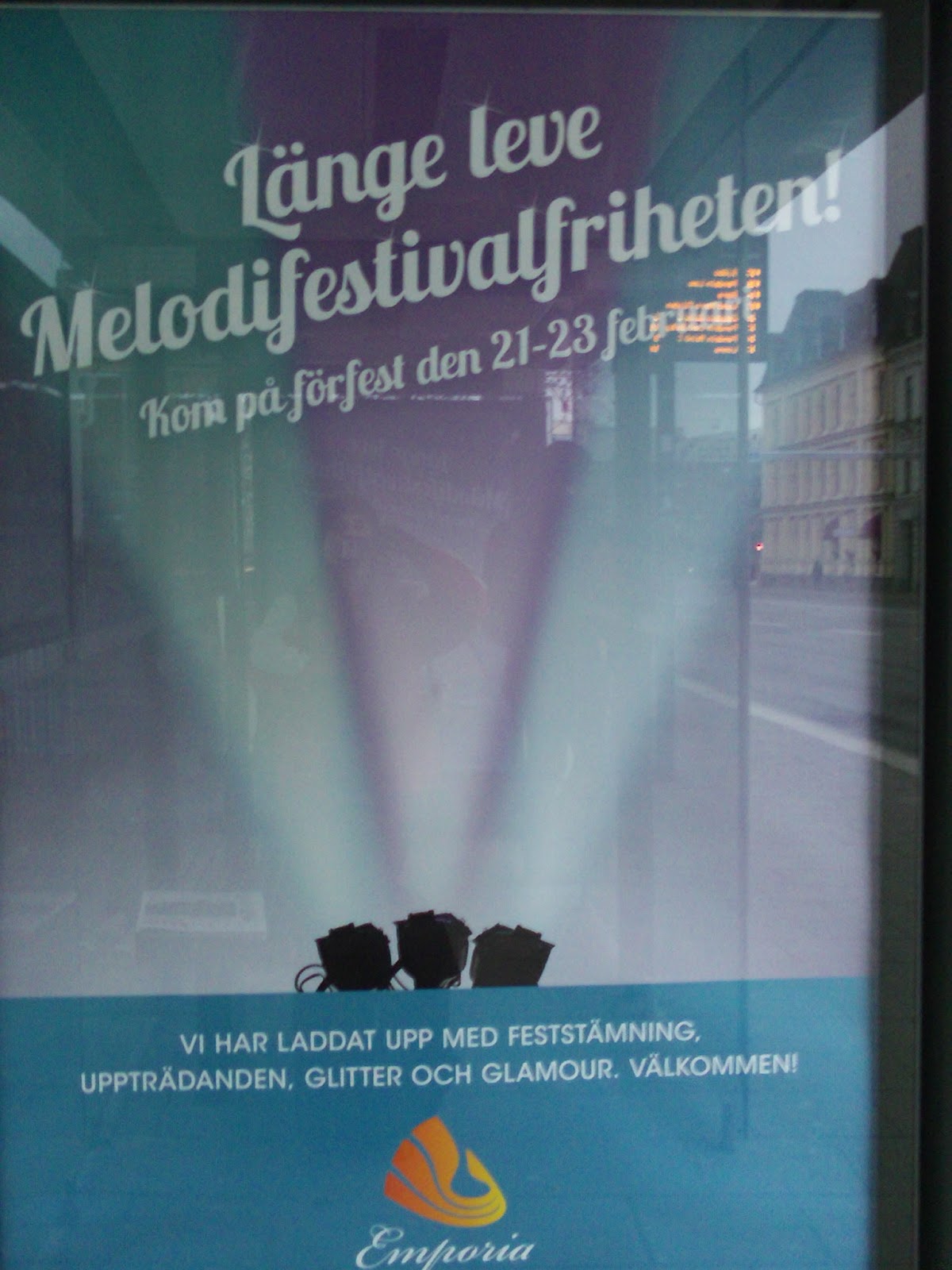
A bus stop ad in Malmö. "Long live Melodifestival freedom". The company wants you to know the shops around Malmö arena will be open late, so you can shop after the concert is over.

A bakery gets into the act. "Malmö sings". This simple ad worked for me.

Melodifestivalen and the Heralding of Spring

Weather is important in Sweden. It shapes the culture and changes the way people live and work. Warm or cold, winter or summer, weather is a major component of everyday life. You can't avoid being affected by it. Swedes celebrate spring and summer through holidays like Valborg and Midsummer and long for its return through holidays like Lucia in December.

Picnicking in the park is a popular way to enjoy nice weather in Sweden.

So, how does Melodifestivalen and weather fit together? The contest begins in early February and lasts until mid March. When the show starts, the country is still draped in snow and ice. By the time the final rolls around six weeks later, the country is starting to slowly warm up. Signs of spring emerge. Snow starts melting. Flowers begin to bloom. The days grow longer and brighter.

In this sense, Melodifestivalen is used as a sort of barometer. You start watching the show that first week. The weather is cold and the nights contain a dull, grey darkness. Around the third week, you notice more light during the days. The sun begins to shine more often. Around the final show, blue skies emerge and flowers begin to bloom. That's when you know the darkest and coldest nights are a memory. In this sense, the song contest helps people count down the remaining days of winter in a fun, enjoyable way.

Sunday, March 10, 2013

Sunny Stockholm

It's another blue sky day in Stockholm.  Today marks my last full day in the city until I begin my travel back home. I just said goodbye to Alexander,  my last CouchSurfing host. He took me out for a mini semla before we parted ways at the central station.

Alexander showed me several sights around town, including the Royal Library, which was a first for me. We ate at several nice places in town and enjoyed chatting about Sweden, the Netherlands, and the United States during our walks. Alexander is currently in an intense study period for his engineering exams. Even though he's busy with his studies, he took time out to show me around Stockholm. For that and all his hospitality, I am grateful!

Opinions about last night's Mello show are still going strong. Everyone at the central station and on the subway was talking about the show after Alexander and I left the student center. The biggest point of conversation was the international jury vote. This contest marks only the third time since 2005 where the official jury's vote changed the end result. This isn't sitting well with the public, since many people feel the general public should have the final say. A few of the newspapers are reporting difficulties voting as well. I sent in a few votes myself and am unsure if any of those made it through. That's not real news though. It happens every year. When you have a million votes trying to get through in an hour and a half, some just won't make it.

I hear there's a song church service at nearby St. Clara church in about an hour. I'll head there and then it's off to find a few interesting things to bring home to family and friends.


Saturday, March 9, 2013

Sweden, We Have A Winner

Twenty-two year old Robin Stjernberg couldn't believe it when the final votes were posted on the board. His face registered disbelief and shock as Yohio and the other artists congratulated him on his win. Stjernberg is the first ever artist to win the entire show after advancing from a Second Chance round.

When Robin was invited back on stage to sing his song to end the show, he could barely sing the first few notes after being overcome with emotion. He beat big contest favorite Yohio and two teen heartthrobs to take the top spot this year with his song, "You", a song about saying thank you to those we love.

Robin Stjernberg's "You" will represent Sweden in Eurovision this May.

Apart from Terese Fredenwall's "Breaking the Silence", his song was my second favorite overall, so I am quite pleased. The audience here at KTH was surprised by the result. Poll questions were asked online and the results were projected on a wall. When the question, "Did the right song win?" was asked, five percent of the audience of about fifty said yes.

The international jury favored Robin over all the others and that's what made the difference. If it weren't for the international jury, Yohio would have won handily. We'll see what the press has to say about the result tomorrow morning.

Gathering for the Grand Finale

Melodifestivalen is a way to socialize. It's a way to connect. It's something to gather around. It brings us together and gives us something to talk about. If you don't watch it, you can't talk about it the next day. I've heard each of these descriptions from different people in the past three weeks. They tell me it is very Swedish to gather for the final with food, a party, and an opinion. In that way, the contest helps people get together, socialize, and enjoy a little time out of life.

Get Ready with Festival Food, a free recipe booklet from grocery store sponsor, Coop.

What better way to celebrate the final event than to do just that? I'll be watching the final with a group of students from the Royal Institute of Technology. Alexander, my CouchSurfing host, is a member of the student union and has invited me along to watch the show on their big screen TV. I've heard their broadcast equipment is top of the line and the sound is impeccable. 

You can watch online via SVT Play, starting at 8 PM CET ( 2 PM Eastern Standard US Time):  http://www.svtplay.se/video/1071366/finalen-med-forsnack

That Schlager Thing Again

There's one "schlager" song in the contest today. I hesitate to write the word without quotation marks. It's because most people would not consider it a true schlager song. It's a song called En Riktig Jävla Schlager ("A D*mn Good Schlager")  by Ravillacz, a group made up of older singers who've had success in Sweden. One of the artists even competed in Melodifestivalen years ago.Yes, the song has the tempo and the correct layout of a schlager. It's catchy and hard to forget, even if you don't speak the language. It gets stuck in your head. However, the song's lyrics are making fun of the genre. 


The lyrics are cleverly written, yet it is still making fun of the genre, the fans, and even the song contest itself. Longtime fans of the contest are typically not fans of this one. That and the song has a cuss word in it, which is repeated many times. This hasn't played well with some families watching the show, as it is billed as a family program. The song doesn't have a chance of winning, but it will probably do well in the charts. It's the only entry this year in Swedish.

True schlager is rare in the contest these days, yet it was the dominant genre over many, many years. Some fans hope for a comeback, but it seems the contest will be filled with a modern blend of uptempo, pop, rock, and rap for at least the next several years.

The Best or the Worst? It Depends.

The song contest creates a reaction and immediate opinion, no matter who you ask. You may hear disgust or delight or even apathy. This year's contest has brought record viewing numbers, yet I initially had difficulty finding people who have watched the program - or will admit to it anyway.

The people at Friends Arena were fans, clearly. They wouldn't have paid money otherwise to be there. Two of those fans are Joakim and Mia. They saw the final last year and decided to watch again this year. The contest is something they grew up with and still enjoy watching today. When they're not watching the final at the arena, they are usually home watching it with friends. Mia thinks the concept of the contest, with six weeks of programming, is a uniquely Swedish idea since other countries in Europe don't spend as much time finding their Eurovision entries.

Joakim and Mia think Yohio will win the contest this year.

Across town, fans at Torget celebrating the contest with a club sponsored Melodifestival evening. These fans mingled and danced to a mix of old and new Mello songs. I met a young gentleman dressed in a Brooklyn NYC jacket outside. I didn't catch his name, but we spoke at length about the contest. He felt it has become too commercial and felt that the artists weren't real. He thinks the artists should both perform and write their own songs. (Several of the artists did so this year, although he was not aware of this to begin with). He even told me Sweden does not deserve to be in the contest and felt the international jury was a bit much. "It is just too much all around", he said. 

I also met a woman named Johanna, who had lived in California. She had been hanging out with several gentlemen from London who had come to Sweden to see the contest too. She introduced me to them and I found out they usually come to Sweden every year to watch! Apparently, the contest has many British fans since Scandinavian pop music is booming, thanks to sites like Scandipop.co.uk.

I also met David and Alexander outside the club just as I was leaving. David started by saying, "This must be the worst year the contest has ever had". "Despite the best ratings in history?", I asked. He told me there is nothing wrong with the music itself, but he is a fan of the classic schlager sound and songs from the 80s. Those genres are nearly nonexistent this year. He feels the music is more pop and electro these days, but he still thinks it's good since Sweden gets more votes at Eurovision later. David also said the contest itself isn't Swedish but the concept itself is Swedish since it gives people a good reason to gather around on Saturday nights and go out afterwards. Alexander thinks the pop music in the contest is typically Swedish since the country has had so much success within the music industry, both nationally and abroad.

Late night photo. David and Alexander outside Torget.

Friday's Practice Round

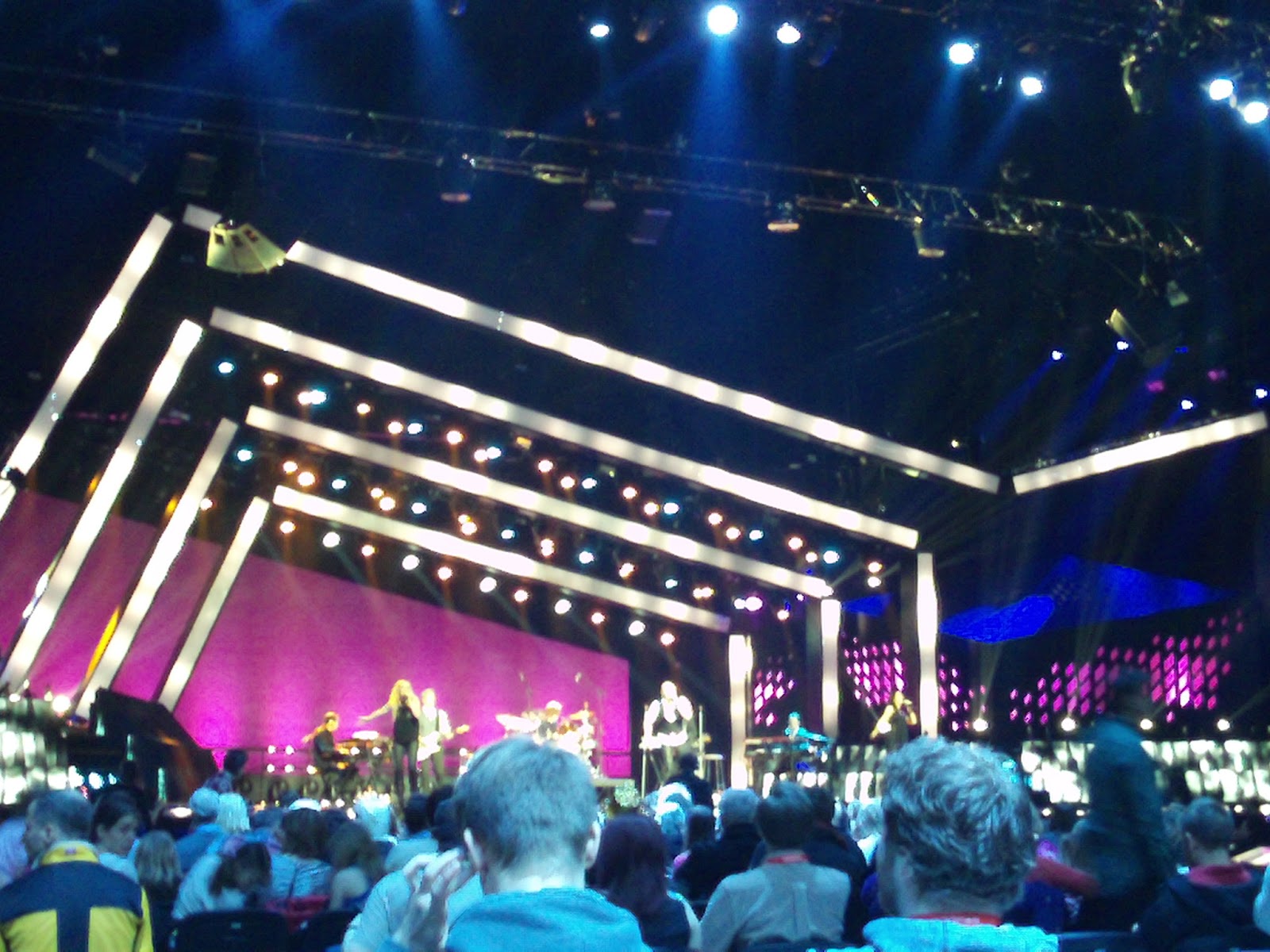
Watching the event live gives you a feeling of excitement and a peek behind the scenes. You miss the close up details from TV, but you gain a unique experience which can't be replicated anywhere else but on the arena floor.

The size of the Friends Arena and the amount of people struck me first. This event is five times bigger than the semi-final in Malmö on every level. The arena itself is Texas sized, and I don't say that lightly. I was not prepared for the sweeping expanse of space. Ulrik Munther's team even made the decision to get a bigger background screen to fit the stage. The scene itself now includes an extra bar on top of the three from previous arenas. I presume these changes were made to help fit the stage to the scale of the arena. Before the show was underway, the stage manager told us to look around and find emergency exits in case anything happened. My closest one was probably a three minute walk.


Advertisers were all over the perimeter of the building again. This time, they practically threw themselves at you to give you free stuff. I'm OK with that. I ended up with free hot chocolate, chips, candy, bags, and a harmonica, of which I can use to annoy people on the subway. If you go to the live event, be prepared to be bombarded with stuff. Don't bring a bag. You'll have plenty to choose from when you get there.

When you're there in person, the sound and live effects go through you, so you feel more of the performance. Feeling the sound, fire, and pyrotechnics can change your perception of a song. During Friday practice rounds, the audience is polled on their favorite performers of the night. Audience members are asked by members of Melodifestivalklubben who they would vote for if they could, since you cannot vote during a practice.  These polls sometimes show popular opinion, but many times they show the best live act. The difference between the Friday night poll and the Saturday night result is due to this live effect.


People around you add to the show as well. The girls next to me had gigantic signs supporting Anton Ewald and Ulrik Munther. They cheered and clapped every time either artists was mentioned and held up their signs during the performances. The family of four behind me were decked out in glittery gold top hats. It's a party atmosphere and it adds to the enjoyment. Kids were everywhere in the arena and every time an artist sauntered up the catwalk, the kids were right there to greet them.


The artist catwalk on TV looks clean and well organized, which it is from the camera's perspective. From an audience view, you can see a lone person (or a few people) surrounded by a sea of onlookers snapping photos, cheering, and standing near their seats. It looks messier in person, but more alive. This also goes for the camera angles. The cameras are omnipresent on the arena floor. They're on cranes, on top of the catwalk, strapped to people, on the roof, and on stage to sweep up every possible angle. Watching the crew work their magic is part of the fun.

The artists look smaller on stage and their humanity is more evident. On TV, you see a polished product. In the arena, you're more likely to see the person waiting to be the artist. They are preparing in those few seconds when the camera isn't on them. They're jumping up and down or standing quietly to calm their nerves before their big entrance. They are themselves before the red light clicks. When it does, they become their artist persona.


I understand why 25,000 people decided to be there for the Friday practice run. It's a laid-back, lighthearted atmosphere offering a unique perspective on the show.

Views from the Arena


Reporters setting up for screenshots.

Up the steps to a Texas sized arena.

The stage now has an extra LED level, presumably so it doesn't look so small in the big stadium.

Melissa showing her support for Sean Banan

Jonas, another crazy Sean Banan fan.

A colorful sign including a photo of Anton from his #1 fan, Felicia.

Friday, March 8, 2013

Oh So Many People

 The last two artists on the schedule are David Lindgren and Yohio:

David Lindgren performing Skyline


David Lindgren's Skyline

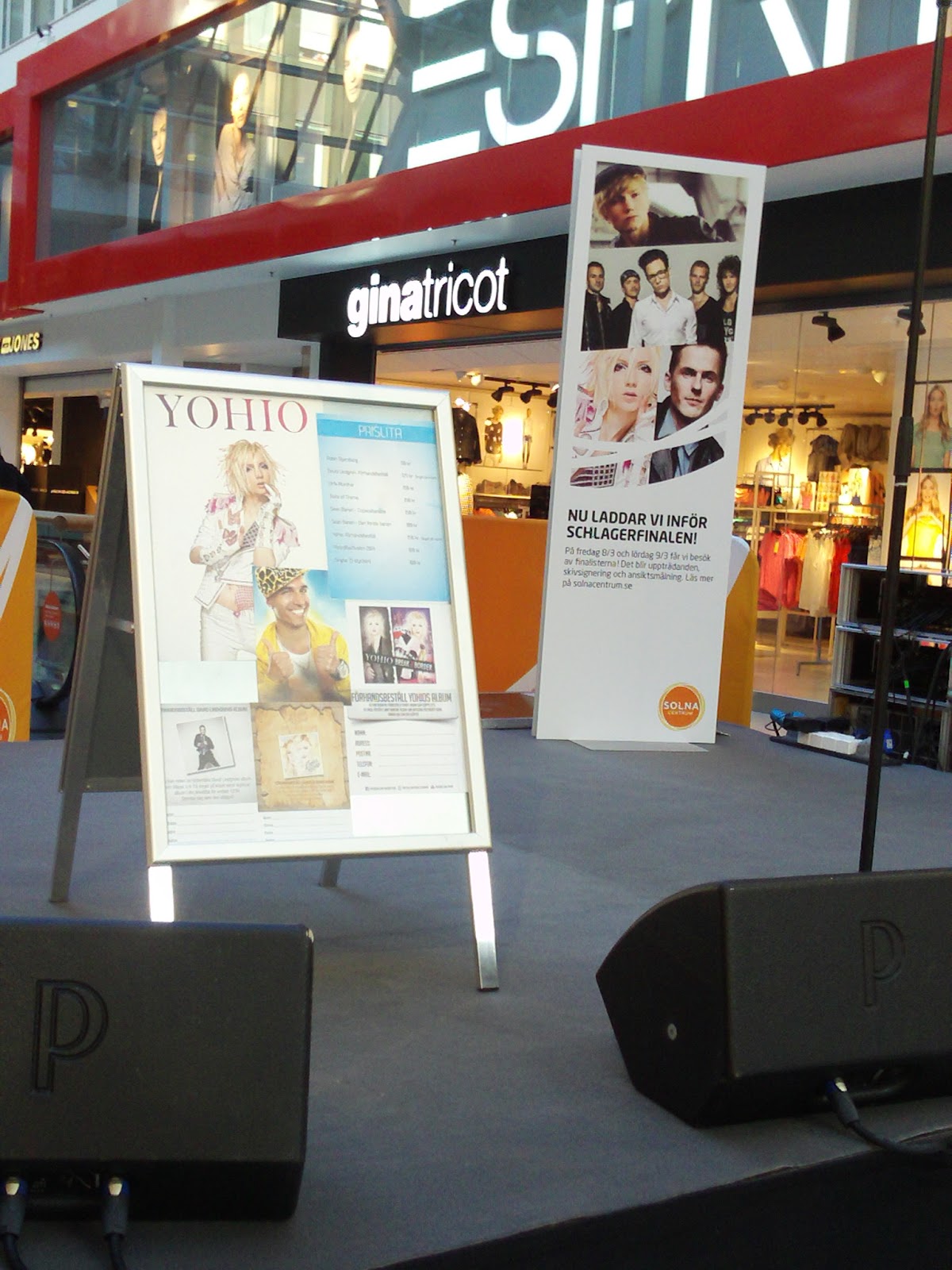
Yohio merchandise for the younger crowd

The elevators are packed and everywhere else, too.

People finding any free space they can get.

The presenter holding up a Yohio poster, which elicited a teen squeal fest. I remember those days. 
                                                                                                                                                                            

Yohio's Heartbreak Hotel

The signing table is wrapped so deep, there's no way Yohio can meet everyone. There was a rush to get to the table after the performance. I was wondering if the shopping center was going to bring out the guards to corral people, but Swedes are still pretty good about order, even when trying to meet their favorite singers. The line is calm yet long. Very long.

Ulrik is Popular

The shopping mall is crowded with young kids and teens because Ulrik Munther just appeared on stage. The line for autographs was out the door. A little girl about three years old just passed me singing Munther's song in perfect English. You have to buy something to get anything signed, but these kids don't mind. Their parents happily give them the cash to buy a CD and meet their favorite singer.

A few photos from the event:


]
The front row waiting for Ulrik Munther

Just one of the many economic opportunities created by Melodifestivalen.

 Ulrik and the presenter chatting. Ulrik did not sing since he's saving his voice for the final.

Girls in a store on the second level watching from above.

Performance Interpretation

Ann-Charlotte from Ave Produktion recently finished chatting with me about her work on Melodifestivalen. Her company has been working with Melodifestivalen for four years now, including this year. They also work with Swedish TV broadcaster SVT on other projects, such as the yearly TV Christmas Calendar.

She explained the process of turning the songs into something that can be understood by someone with hearing difficulties. The interpretation artists working at Ave begin by transforming each song into an entirely new performance, while still keeping close to the original meaning of the song. Metaphors are difficult to translate, Ann-Charlotte noted, so the artists transform the meaning instead of translating them. In Sweden, there are about 10,000 people who require sign language but 100,000 who tune into the work Ave Produktion is involved with on a daily basis. Performance interpretation work for Melodifestivalen begins in early summer and lasts until the final show in March.

Ann-Charlotte also mentioned the popularity of Ave's performance interpretations with the hearing community. She explained that Ave's interpretation work provides a third dimension for the hearing community. The general public can hear and see the songs, but Ave's work allows them to experience the songs as well.  Last year, the company received larger recognition within the press when their work was uploaded online. Clips on YouTube helped introduce the concept of performance interpretation to the general public.

Their interpretation work is shown side by side with each Melodifestival broadcast and can be accessed online via SVT Play while the show is underway.

Take a look at some of their work from last year:


Solna, Friends Arena, and Stockholm

I've made it to the place just outside Stockholm called Solna. It's where Friends Arena is located, which is where Melodifestivalen will be held this year. The arena opened just last year and can seat 65,000 people, although there won't be that many there for the practice round tonight or the final show tomorrow.

A few artists will show up for an appearance at the Solna shopping mall in a few hours. Some teens are already camping out. Reminds me of myself at fifteen. The city's main library is located within the shopping mall too. It's a convenient and handy place to hang out in between artist appearances.

Before that, I will go to Friends Arena to meet with a representative from Ave Produktion, a company who interprets TV shows, such as Melodifestivalen, for the deaf and hard of hearing. How do you interpret music and sound into sign language? Ann-Charlotte Sparby from Ave Produktion will fill in the details.

The practice for the final round is tonight at 7 PM. I'll be there to chat with people, see the show before it airs tomorrow, and report back on the event before it airs live on TV.

I'll end up in the Old Town of Stockholm tonight where a club called Torget is holding a Melodifestival theme from 10 PM to 1 AM. The event is sponsored by a British website called Scandipop. They are known for its in-depth reporting on Scandinavian pop music. I'll find some faces in the crowd and ask them what they think about this year's show.

I will try to get in as many blog entries as possible, although there may be some gaps between posting. Keep an eye out for the updates.

Thursday, March 7, 2013

Sweden's Tradition of Song

Swedish culture is awash in song. Children usually learn an instrument when they're small, or at least try. Singing in a choir is a near national pastime with one of every seven people involved at some point. Music is an integral part of almost every holiday and celebration. And many of the biggest TV shows revolve around music (Så Ska Det Låta, Allsång på Skansen, Maestro, Så Mycket Bättre, Melodifestivalen....)

Rodrigo Rivas Ruiz/imagebank.sweden.se

In a country the size of California, the industry is booming. More people work in the music industry than in the automobile industry. It's not just within the country, but also outside its borders too. Some of the biggest International acts get help from Swedish songwriters and producers.

American Artists who've worked with Swedish songwriters and producers include Christina Aguilera, Brittney Spears, Jessica Simpson, Kesha, Madonna, Jennifer Lopez, Cyndi Lauper, Kelis, Janet Jackson, Santana, LeeAnn Rimes, Bon Jovi, Carrie Underwood, Katy Perry, Kelly Clarkson, Taylor Swift, Pink, etc.

You'll notice the above list is dominated by pop acts. Swedes excel in the genre and are often asked to write original material for other projects too, such as Glee and American Idol.

With so many talented singers, songwriters, and producers to pull from, it's no wonder Sweden's Eurovision qualifier developed into such a large production.